If you're an adult who wants to learn violin from home, there has never been more choice. You can download an app, join an online course, book a teacher through a marketplace, or work directly with a private teacher over video. Each one promises to help you play, and they work in genuinely different ways.
I look at these options from two angles. I'm a violin teacher who teaches adults online, and I also work in software and learning design, building tools that help people learn. So I care about what a learning tool does well, and about where a person still makes the difference.
My honest answer is that the best online violin lessons depend on what kind of feedback you need. Apps are good at listening for pitch and rhythm and keeping you practicing. Self-paced courses give you a structured curriculum and a deep library to work through at your own speed. Marketplaces make it easy to find and try live teachers. And live private lessons give you a teacher who watches your posture, bow, and hands and adjusts each lesson to you. Many adults do best combining a live teacher with good practice tools.
Last reviewed . Provider details come from each provider's official website and app listing; please confirm current offerings directly.
The Four Ways Adults Learn Violin Online
- Learning apps: software that listens to you play and responds, usually alongside built-in lessons and songs
- Self-paced online courses: a structured video curriculum you work through on your own schedule, sometimes with options to get feedback
- Teacher marketplaces: platforms where you browse, try, and book independent teachers for live online lessons
- Direct private lessons: an ongoing, one-on-one relationship with a teacher you work with live over video
None of these is the "right" way for everyone. They differ mainly in who gives you feedback, how often, and on what.
Online Violin Lessons for Adults at a Glance
Here's how my studio and three other online options compare on the same points, including who each one tends to suit. "Not described" means the detail wasn't on the provider's website when this guide was reviewed, not that it doesn't exist.
| Option | Learning model | Who teaches | Feedback on your playing | Pace & scheduling | Best suited for |
|---|---|---|---|---|---|
| Vibrations Violin Studio Our studio | Live private lessons online with one teacher | Rae McGee: Suzuki-trained violinist (master's in violin performance) and learning designer | Live in every lesson, from a teacher watching and listening | Paced to you; 30, 45, or 60-minute lessons; 20-minute trial | Adults who want individualized guidance and real-time feedback on technique |
| ViolinLab | Self-paced video curriculum for adults | Course creator Beth Blackerby | Recorded video exchange with the instructor (Premium tier); live Zoom classes and forum for members | Self-paced; Beginning, Intermediate, and Advancing tracks | Self-motivated adults who want a structured course and a large library |
| Trala | Violin learning app (iOS and Android) | Lesson content featuring professional violinists | Automatic pitch and rhythm feedback as you play; live teacher access not described on its website | Practice any time in the app | Adults who want flexible, app-based practice with instant feedback on notes and rhythm |
| Lessonface | Marketplace for live online teachers | Teachers vetted by Lessonface; you choose | Live from your chosen teacher over Zoom; one-on-one or group classes | Single lessons, packages, or weekly; 24-hour cancellation | Adults who want live lessons and like comparing several teachers |
Tradeoffs at a Glance
Every option involves tradeoffs. Here's the main one to weigh for each.
-
Vibrations Violin Studio · Our studio
Lessons 10am–7pm Mountain time; no self-paced library
-
ViolinLab
Individual feedback is recorded, not live; video exchange on Premium only
-
Trala
Automated feedback can't see posture, bow hold, or tension
-
Lessonface
You choose a teacher; experience varies by instructor
Curious whether live lessons would suit you? Book a free 15-minute intro call and we can talk it through.
The Options, Up Close
ViolinLab
ViolinLab is an online violin school created by teacher Beth Blackerby and, in its own words, designed exclusively for adult learners. Its curriculum is organized into Beginning, Intermediate, and Advancing tracks, with a large library of video lessons, repertoire, and downloadable sheet music, plus practice tools like play-along accompaniments and a drone and metronome tool. Members can join live Zoom classes and a community forum, and its Premium tier adds a video exchange: you send a recording and receive a response from Beth, typically within a few business days. The Beginning track requires no prior experience, and returning players are encouraged to revisit its fundamentals course.
Strengths: a deep, adult-focused curriculum, a clear progression, and real feedback from an experienced teacher through recorded video. Tradeoffs to consider: feedback arrives after you send a recording rather than in the moment, and you set your own pace and practice plan. May suit: self-motivated adults who like structure, want a large library to explore, and are comfortable learning between occasional feedback points.
Trala
Trala is a violin learning app for iPhone, iPad, and Android, now owned by Learnfield, the company behind the piano app Skoove. According to its app listing, Trala uses signal processing to analyze the sound of your violin and give you instant feedback on pitch and rhythm as you practice. It includes a built-in tuner, progress tracking, an interactive sheet music library, and lesson content featuring well-known violinists such as Joshua Bell, Katie Jacoby, and Kiana June Weber. Its website describes the method as built for adult learners, including people returning to the instrument. Its current website doesn't describe live lessons with teachers, so if that matters to you, it's worth asking Trala directly.
Strengths: immediate feedback on notes and rhythm every time you practice, practice whenever it suits you, and engaging repertoire across styles. Tradeoffs to consider: an app listens to your sound, so it can't see your posture, bow hold, or tension the way a person can. May suit: adults who want to try violin with a low commitment, enjoy app-based practice, or want extra help with intonation and rhythm between lessons.
Lessonface
Lessonface is a marketplace that connects students with teachers for live one-on-one lessons and group classes over Zoom. Its teachers are vetted by Lessonface staff, and you can either search teacher profiles, which include teaching styles and demo videos, or describe your goals and get matched. Depending on the teacher, you can book a single lesson, a package, or weekly lessons, and some teachers offer a short trial. Lessonface has a 24-hour cancellation policy and hosts community recitals and open mics.
Strengths: live feedback from a real teacher, a wide choice of teachers and styles, and an easy way to try someone before committing. Tradeoffs to consider: experience with adult beginners varies from teacher to teacher, so it's worth reading profiles carefully and asking. May suit: adults who want live lessons and like the idea of comparing several teachers in one place.
"The best learning tools support the relationship between student and teacher. They don't try to replace it."
What an App Can Hear, and What a Teacher Can See
Pitch and rhythm detection is genuinely useful. Software can tell you right away when a note is sharp or a rhythm is rushed, every time you practice, which is something no weekly teacher can do.
What sound alone can't tell you is why a note is out of tune or why your tone is thin. Often the cause is physical: a collapsed left wrist, a stiff bow thumb, a bow drifting toward the fingerboard, or tension in the shoulder. A teacher watching you play can spot those causes and help you change them, which is how lasting habits get built.
To be fair, a live online teacher has limits too. A camera shows one angle at a time and a microphone softens fine details of tone, so good online teaching relies on adjusting the camera and asking you to describe what you feel. Online vs. in-person violin lessons goes into those tradeoffs in more depth.
How to Choose What Fits You
- Your goals: trying violin casually, learning favorite songs, or building solid classical technique
- Your experience: complete beginners and returning players often need different kinds of help
- Feedback: whether automated pitch and rhythm feedback is enough, or you want someone watching your setup
- Budget model: apps and courses are usually subscriptions, while live lessons are usually paid per lesson or monthly
- Schedule: practice-any-time tools versus a regular lesson time that keeps you accountable
- How you learn: some people thrive self-directed, while others do best with a person to ask questions and adjust the plan
These options also combine well. Plenty of adults take live lessons and use an app or course for extra practice between them.
Getting Started with Online Violin Lessons
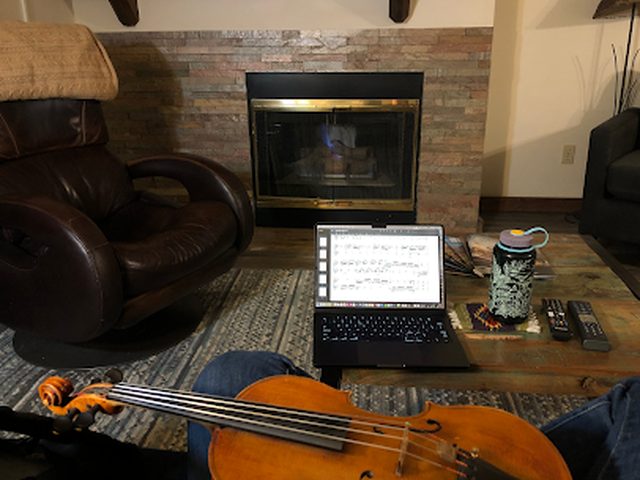
You don't need much to begin: a violin that's sized and set up properly, a quiet space where you can stand and move your bow freely, and, for live lessons, a laptop or tablet with a camera you can angle to show your whole upper body. If you don't have a violin yet, it's worth getting advice before you buy. Can you learn violin online covers what a simple home setup looks like, and the real timeline of learning violin as an adult sets realistic expectations for your first months.
How I Teach Online at Vibrations Violin Studio
I teach live private violin lessons online for adults who aren't in Denver or who simply prefer learning from home, alongside my in-person lessons in Denver. I hold a master's degree in violin performance, completed Suzuki pedagogy training, and have taught for about twenty years. My lessons are Suzuki-informed rather than Suzuki-only and shaped around your goals, whether you're beginning for the first time or returning after years away.
Lessons are 30, 45, or 60 minutes, with a 20-minute trial lesson to start. Current rates are listed in rates and lesson options.
How my lessons are structured
Good violin teaching and good learning design rest on the same few ideas, and I use them in every lesson:
- Individualized instruction: each lesson starts from where you are that week, your goals, and the music you care about, not a fixed script
- Scaffolded skill development: complex skills like a relaxed bow arm or in-tune shifting are broken into small, achievable steps that build on each other
- Formative feedback: I give specific, in-the-moment feedback while you play, so you can try an adjustment right away and feel the difference
- Learner-centered pacing: we move on when a skill feels secure for you, and slow down or approach it another way when it doesn't
You leave each lesson knowing what to practice next and why. Everyone's progress looks different, and the aim is a learning experience that responds to you as you grow.
Where violin teaching meets learning design
Outside the studio, I design accessible learning technology, combining my experience in music education and software to create tools that help people learn more effectively, for clients such as the National Center on Education and the Economy. As a human-centered designer, I focus on how people actually learn: where they get stuck, what keeps them motivated, and how to make the next step feel achievable. I bring that same lens to lesson planning, and it shapes how I think about learning tools too: not just what features they offer, but how they support real people as they practice.
It's also why I'm building Practice Pals, a practice support tool for beginner violin students that grows out of real student needs. It's still in the research and development phase and isn't available yet, and its shape will keep changing as it's tested with real students. The goal is to support the time between lessons while keeping the teacher-student relationship at the center.
Frequently Asked Questions
Are violin learning apps enough for beginners?
They can be a great start, especially for exploring violin and building practice habits. Apps that listen for pitch and rhythm give useful feedback, but they can't see your posture, bow hold, or tension. Many beginners use an app alongside a teacher who checks those foundations.
Can an online teacher correct my technique?
Yes, in most cases. A teacher watching you over video can see your posture, bow path, and left-hand setup and help you adjust them in real time. Adjusting the camera angle helps, and some fine details are easier to refine in person.
Is Trala or ViolinLab better?
They're different kinds of tools. Trala is an app that listens to you play and gives instant pitch and rhythm feedback. ViolinLab is an adult-focused video curriculum with options for recorded feedback from its instructor. The better fit depends on whether you want app-based practice or a structured course.
What's the best online option for a returning violinist?
Returning players often benefit from a teacher who can assess where they actually are, since some skills return quickly while old habits may need attention. A self-paced course can also work well if you're comfortable judging your own progress.
Live Online Violin Lessons for Adults
Vibrations Violin Studio offers live private violin lessons online for adult beginners and returning players, as well as in-person lessons in Denver, Colorado. Lessons are Suzuki-informed and built around your goals, pace, and the music you want to play.
If you're weighing your options, whether that's my studio, an app, a course, or another teacher, you're welcome to reach out for a low-pressure conversation.
Book a 15-Minute Intro Call