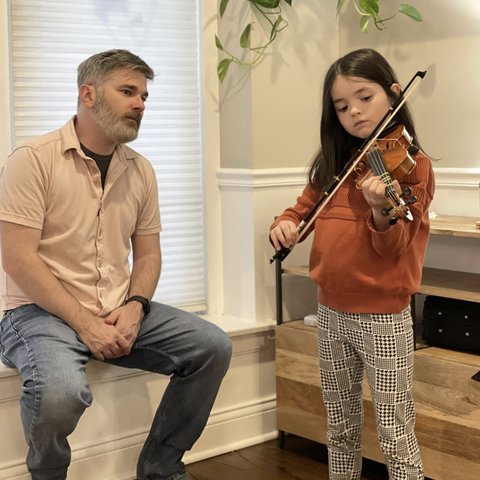
Parents often ask me, "What's the right age to start violin?"
The short answer is that there isn't one perfect age. There is no single best age to start violin. Some children can begin with age-appropriate instruction around ages three or four, while others are better suited to beginning later. Interest, attention, willingness to experiment, family support, and the teacher's ability to adapt instruction are often more useful indicators of readiness than age alone.
So rather than asking only, "Is my child old enough?" I usually think a more useful question is: "Is my child ready for the kind of violin learning that's appropriate for their age?"
What Is the Best Age to Start Violin?
Children can begin violin at a range of ages, and starting earlier is not automatically better.
A very young beginner may spend substantial time learning through listening, imitation, movement, games, simple musical patterns, instrument routines, and very small physical skills. An older beginner may be ready to understand verbal explanations, work more independently, read music sooner, or sustain attention for longer stretches.
Both are real violin learning.
The goal is not to get a child through material as quickly as possible. The goal is to give them an introduction to music that makes sense for who they are right now and gives them room to grow.
Can a 3- or 4-Year-Old Start Violin?
Yes, some three- and four-year-olds can begin violin lessons successfully, but lessons for a very young child should look different from lessons for an older beginner.
At this age, it's reasonable not to expect a child to sit still for a long traditional lesson, understand lengthy technical explanations, or independently manage practice.
Early lessons may include listening, rhythm, movement, imitation, learning how to hold the instrument and bow, short games, and tiny achievable musical tasks.
Parent or caregiver involvement is also particularly important for very young beginners, since much of the learning continues through simple routines at home. A child's curiosity and willingness to participate matter more than whether they can already behave like an older music student.
What About Starting Violin at 5, 6, or 7?
These can be wonderful ages to begin.
Many children at this stage are increasingly able to follow multi-step directions, notice physical details, remember lesson routines, communicate when something feels confusing, and participate more actively in practice.
But children develop differently. One six-year-old may love detailed instruction while another needs considerably more movement, play, listening, and experimentation. Good beginner teaching should adapt to the learner rather than expecting every child of the same age to learn in exactly the same way. Once a child does begin, what the first three months of violin lessons tend to look like can help set realistic expectations for those early weeks.
Is 8, 9, or 10 Too Late to Start Violin?
Not at all.
One of the easiest traps for parents is seeing children who started very young and assuming their own child has somehow missed a window. They haven't.
Older beginners often bring advantages of their own: greater physical awareness, longer attention spans, stronger reading skills, more independence, and sometimes a clearer personal desire to learn the instrument.
Starting violin is not a race to begin at the youngest possible age. A motivated older beginner can build strong technique, musicianship, and a meaningful relationship with music.
"There is no prize for starting earliest. What matters much more is building a relationship with music that gives a child room to grow."
Signs Your Child May Be Ready for Violin Lessons
Instead of looking for a strict age cutoff, it helps to pay attention to readiness signals. Your child may be ready to explore lessons if they show some combination of these:
- They are curious about the violin or music.
- They can engage with another adult for short periods with appropriate support.
- They are willing to imitate, experiment, or try something more than once.
- They can tolerate small amounts of frustration without every difficult moment ending the activity.
- They enjoy listening to music, making sounds, moving to rhythm, or exploring instruments.
- For younger children, a parent or caregiver is willing to participate in establishing simple routines at home.
None of these needs to be perfect. Readiness is not the same thing as already knowing how to be a violin student. Learning how to learn the instrument is part of what lessons are for.
Your Child Does Not Need to Show "Talent" Before Starting
Natural talent isn't a useful test for whether a child should begin. Beginners are beginners.
Coordination can be learned. Listening develops. Musical understanding grows. Focus changes with experience. Children become more capable by doing things they could not already do.
What matters much more is whether the learning environment gives a child appropriate challenges, useful feedback, room to make mistakes, and reasons to stay curious. A child does not need to prove that they deserve music lessons by already being good at music.
The Teacher Matters as Much as the Starting Age
A four-year-old and a ten-year-old should not simply receive smaller and larger versions of the same lesson.
Teaching young beginners requires adapting pacing, communication, expectations, repertoire, physical activities, and the role of the parent to the student in front of you.
My own teaching at Vibrations Violin Studio is Suzuki-informed but individualized. Listening, imitation, repetition, and family support can be extremely valuable, particularly for younger learners, while student interests, learning differences, growing independence, and musical agency also matter.
The question therefore isn't only whether your child is ready for violin. It's also whether the teacher and lesson environment are ready to teach your child as the learner they actually are—which is really a question of fit. If you're weighing options, how to know if a violin teacher is a good fit goes deeper into what to look for.
What If My Child Is Interested but I'm Still Unsure?
You do not need to predict your child's entire musical future before allowing them to begin.
Starting violin can simply be the beginning of learning more: how your child responds to the instrument, what kind of support helps them, what they enjoy, what challenges them, and whether the teacher-student relationship feels right. A thoughtful first violin lesson should help answer those questions rather than requiring your family to know all the answers beforehand.
At Vibrations Violin Studio, families can begin with a short discovery conversation to talk through age, readiness, goals, previous musical experiences, and any concerns before deciding on the next step.
So, When Should Your Child Start Violin?
Start when there is enough curiosity and readiness to make the experience meaningful, and when you can find instruction appropriate for the child in front of you.
For one family, that might be age three or four. For another, it might be six. For another, it might be nine or twelve.
There is no prize for starting earliest. What matters much more is building a relationship with music that gives a child opportunities to develop skills, curiosity, confidence, patience, and the experience of getting better at something over time.
Wondering Whether Your Child Is Ready?
Vibrations Violin Studio offers individualized violin lessons for children and adults in Denver, with online lessons also available.
A free 15-minute discovery call is an easy place to ask questions about age, readiness, instruments, lessons, or teacher fit—no pressure to commit to anything.
Schedule a Discovery Call