Starting violin lessons brings a lot of firsts: a first instrument, a first bow hold, a first weekly practice routine.
It's natural to wonder what actually happens during those early weeks — what a first lesson covers, how quickly a student moves from open strings to real music, and what a reasonable home routine looks like.
This is a practical look at the first three months of violin lessons: what setup and instruction may include, how skills tend to build on each other month to month, and what parents and adult beginners can expect to be doing at home in between lessons.
Every teacher sequences material a little differently, and no two students move through it at exactly the same pace. But here is a realistic picture of how the first ninety days commonly unfold.
Before the First Lesson: Instrument, Setup, and Expectations
Before diving into technique, most teachers start with the instrument itself. In a first lesson, that often means confirming that the violin is an appropriate size, checking the bow's condition and hair tension, and making sure a shoulder rest or sponge fits comfortably. If a family is still deciding whether to rent or buy, choosing or renting a first violin is usually part of that first conversation too.
You do not need to already know how to read music, tune a violin, or name the parts of the bow. That's part of what the first weeks are for.
It also helps to walk in with realistic expectations about how quickly things click. Many beginners arrive with common expectations beginners bring to violin lessons that don't quite match how learning actually unfolds.
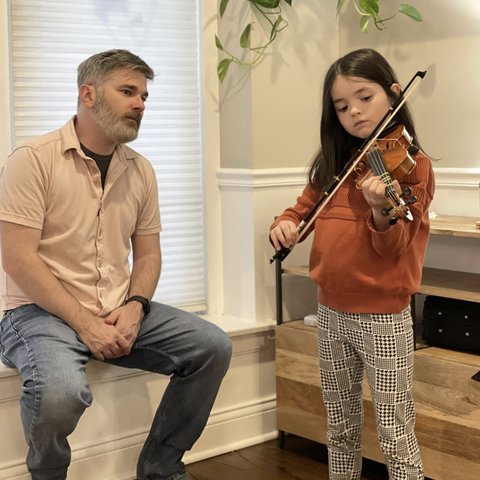
Young children and adult beginners tend to arrive with different needs. A six-year-old may have a short attention span but few preconceptions about how the process should go. An adult may grasp an explanation instantly but need more repetition to build the physical coordination behind it. Good early instruction accounts for both.
Month One: Learning How the Violin and Bow Work
The first month is largely about physical basics: how to hold the instrument, how to hold the bow, and how the two work together.
Early lessons commonly include:
- finding a comfortable, balanced way to hold the violin
- building an initial bow hold
- drawing the bow across open strings
- listening for the difference between a clear tone and a scratchy one
- simple rhythm exercises, often paired with movement or clapping
- short, repeated home assignments rather than long practice blocks
Complete songs usually come later, once the bow arm and left hand have some of this foundation in place. Skipping ahead to a recognizable tune before those basic mechanics are workable tends to create frustration rather than results, so most teachers hold off on purpose.
What Practice May Look Like During Month One
At home, month-one practice is usually short and specific — a few minutes spent on one or two clearly defined tasks rather than an open-ended session.
For young children, this often works best with a parent nearby, helping keep track of the assignment and offering a second set of eyes on posture. For adults, it can help to think in short blocks — five or ten focused minutes, more than once a day, rather than saving practice for one long sitting.
There is no single correct number of minutes. A teacher will typically give more specific guidance based on the student's age, schedule, and what was covered that week.
Month Two: Combining Skills Into Simple Music
By the second month, students are usually putting pieces together — coordinating the bow with left-hand fingers instead of practicing each separately.
This often includes:
- simple melodies or short musical patterns
- early note-reading, learning by ear, or a mix of both
- steadier rhythm across a full phrase
- more attention to bow placement and the resulting tone
Combining skills can temporarily make things sound less polished. A student with a clean, focused sound on open strings might sound rougher once fingers enter the equation. That's a function of complexity, not a step backward — the ears and hands are being asked to track everything at once instead of one thing at a time.
"The goal of the first three months isn't a polished sound. It's building the physical and listening habits that make everything afterward possible."
What Practice May Look Like During Month Two
When something isn't coming together, it often helps to separate the pieces again — practicing the left-hand fingering alone, then the bowing alone, before putting them back together.
Short repetition still matters more than long run-throughs. Repeating four measures slowly and accurately tends to do more than playing a whole piece start to finish and hoping it improves on its own.
Most students aren't practicing independently at this stage. A written or verbal list of priorities from the teacher — what to work on first, second, and third — usually does more for a home session than an open-ended instruction to "practice for twenty minutes."
Month Three: Building Familiarity and Early Independence
Around the three-month mark, familiar tasks tend to take less conscious effort. Setting up the instrument, finding the first note of a familiar piece, or starting a known warm-up may happen with less step-by-step guidance than it did in month one.
Other common shifts around this point:
- steadier awareness of rhythm and sound
- the ability to start a known practice task without being walked through it
- more specific questions during lessons, rather than general uncertainty
- an early musical preference — a piece worth playing again, or a sound the student is drawn to
- a weekly routine that fits more easily into the rest of the week
It's common for a student's playing to still sound distinctly like a beginner's at this stage, even as the process itself becomes more familiar. Sound quality and technical polish typically take longer than three months to develop — the shifts described here are mostly about how the learning is going, not about performance level.
If what you're really weighing is whether your child's pace itself is on track, how to think about whether a child's violin progress is typical goes deeper into that specific question.
How the First Three Months May Differ for Children and Adults
The same three months can look quite different depending on the student's age.
Young children often learn best through games, movement, imitation, and short bursts of repetition, with a parent helping translate lesson instructions into home practice. Sitting still and following written instructions usually isn't the primary teaching method at this age. If you're still deciding when to begin, how old a child should be to start violin covers what readiness can look like at different ages.
Adults frequently grasp the reasoning behind a technique right away, but the physical coordination still takes the same repetition to build as it does for anyone else. Adults also tend to bring more self-criticism into the room — a habit of perfectionism, or a specific idea of where they "should" be by now, that can get in the way of the patient repetition the first few months actually require. For a longer look at how that plays out over a full year rather than just the first three months, see the broader timeline of learning violin as an adult.
Neither path is faster or better. They're simply different starting points that call for different teaching approaches.
What Parents and Adult Learners Can Ask After Three Months
Three months in, it's reasonable to check in with the teacher about where things stand. Useful questions include:
- What foundational skills are becoming more secure?
- What should practice focus on next?
- Is the instrument's size and setup still a good fit?
- Which current practice habits are actually helping?
- Where does the student need a different explanation or a smaller step?
- What do you recommend focusing on over the next three months?
A short conversation like this gives both the student and the teacher a clearer sense of direction heading into the next stretch.
When to Talk With the Teacher Sooner
Some situations are worth raising before the three-month mark. It's worth reaching out sooner if:
- the student experiences pain or physical discomfort while playing
- practice assignments are consistently unclear from week to week
- practice sessions repeatedly turn into conflict
- the student seems persistently lost or discouraged rather than just challenged
- the teaching style doesn't seem to fit how the student learns
- the instrument may be the wrong size or improperly set up
None of these need to turn into a big conversation. A quick note or a few minutes at the start of a lesson is usually enough to make an adjustment.
Starting Violin Lessons in Denver or Online
Vibrations Violin Studio offers personalized, Suzuki-informed violin lessons for children, teens, and adults in Denver, Colorado, and I'm happy to talk through how online violin lessons can work for students learning remotely.
If you're weighing whether lessons might be a good fit — for yourself or your child — you're welcome to start with a low-pressure conversation before committing to anything.
Start a Conversation