For most new students, one lesson a week is a sensible place to start. A week is usually long enough to try something on your own, and short enough that your questions are still fresh when you come back. But weekly is a common starting point, not a rule. The right lesson rhythm balances useful feedback, independent practice, your sense of ownership, and what your life can sustain.
More lessons aren't automatically better, and a slower rhythm doesn't mean less commitment. This guide covers how often to meet with a teacher and how long those lessons should be. How much to play between lessons is a separate question, covered in how much beginners should practice violin.
Weekly vs. Biweekly Violin Lessons
By "biweekly," most people mean every other week, so that's how I'm using it here. Neither rhythm is the better one. Each gives you something and asks for something.
| Aspect | Weekly | Every other week |
|---|---|---|
| Feedback | A check-in every 7 days | A check-in every 14 days |
| On your own | A few clear things to try | A longer plan you can carry yourself |
| Schedule | A steady routine, with less slack | More breathing room in full months |
| Per month | 4 or 5 lessons | 2 or 3 lessons |
| Tradeoff | More time and money each month | A longer wait when you get stuck |
Every-other-week lessons tend to work best when someone can already notice what's happening in their playing and work through a problem between check-ins. That's a skill that develops with experience. It has nothing to do with how much a person cares.
A note on my own studio: I don't offer every-other-week lessons, but alongside weekly lessons, three lessons a month with one week off is an option. If neither looks workable for you, tell me. We can talk honestly about what's possible, including whether another teacher's schedule would suit you better. For budgeting, what violin lessons cost covers current rates.
What Learning Science Actually Tells Us
The honest answer starts with a gap. A literature search for this article didn't turn up a peer-reviewed study comparing weekly and every-other-week private violin lessons. A review of 296 publications on music practice lists topics like practice strategies and self-regulation as its most common, not lesson schedules.[1] A recent systematic review of violin teaching looks at teaching approaches rather than how often lessons happen.[2] So research doesn't prove that weekly beats biweekly, or the reverse.
What we do have is evidence on nearby questions, mostly about practice rather than lessons:
- Spacing helps memory. A synthesis of 317 experiments on verbal recall examined distributed practice and found that the most useful gap grows with how long you need to remember something.[3]
- Music results are less settled. In one study of 29 musicians learning a short keyboard sequence, accuracy improved at the second session only when sessions were 24 hours apart, rather than 5 minutes or 6 hours.[4] Another study of 100 students, most of them new to piano, found no benefit from gaps of up to 15 minutes, and its authors described music spacing research as inconclusive.[5]
- More feedback isn't always better. In motor-learning experiments, reducing how often learners received feedback improved skill learning,[6] and learners who chose when to get feedback showed learning benefits over those who couldn't.[7] These were laboratory tasks, not violin lessons.
None of these studies measured paid lessons a week or two apart. They looked at gaps of minutes to days, or feedback on individual attempts.
My own view, as a teacher rather than as a research finding: the days between lessons matter as much as the lesson itself. The useful question is whether a student has enough guidance to use those days well, and enough say in the process to stay engaged.
Different Learners Need Different Rhythms
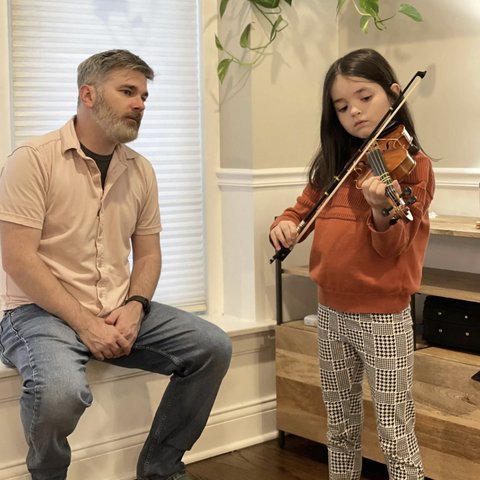
Young beginners. Almost everything is new, and a young child depends on an adult to carry the plan home. In Suzuki-informed teaching, that adult is part of the learning, so the schedule has to work for them too. A steady weekly rhythm often helps children and caregivers settle in. If you're still weighing formats, here's a guide to children's lesson options in Denver.
Adult beginners. Adults often bring focus and good questions, along with work, family, and travel. A weekly lesson can anchor a busy life. It can also feel like one more deadline if you rarely get to play in between. Be honest about an ordinary week, and compare adult lesson options in Denver if you're still exploring.
Returning players. You may remember more than you expect while your body catches up. Some returners want weekly structure at first, and others do well with more time between lessons once their footing is back. Returning to violin after years away covers what that restart can feel like.
Learners who benefit from adaptive pacing. Some students, neurodivergent or not, learn best with fewer new ideas at once, a predictable routine, more repetition, or more time to process. That might mean shorter lessons, one focus at a time, written notes, or more room between new material. Two people with the same diagnosis may want opposite things, and you never need to share one with me. Tell me what helps, and we'll build from there.
Choosing 30, 45, or 60 Minutes
Length is its own decision. It depends on attention, physical stamina, learning stage, musical goals, and what fits your calendar. Longer doesn't mean more serious, and a lesson should end before focus or comfort runs out. Here's how the options at my studio tend to break down, with current rates and details on the About page:
- 30 minutes ($50). Recommended for ages 6 and up. Often a good fit for newer learners of any age: one or two clear ideas, with attention still intact at the end.
- 45 minutes ($75). Room for technique, repertoire, and questions. Often suits older children, curious adults, and students whose music has grown.
- 60 minutes ($100). Best for advanced students or intensive focus, when the material and stamina can fill the hour.
Deciding between 30 and 45 minutes? Notice whether a shorter lesson would leave you wanting more, or whether a longer one would leave you tired. You can also start with a 20-minute trial lesson to get a feel for how we work together. If your child is under 6, ask me what would make sense for them.
Find Your Starting Rhythm
These aren't rules, just a way to narrow things down:
- Everything is new: Start weekly, at a length you can stay attentive for.
- You have a specific goal or date: Weekly lessons give you more chances to adjust along the way.
- You want more feedback: Shorter, more frequent lessons usually mean more check-ins for the same total minutes.
- You're experienced and work well independently: More time between lessons may be worth discussing with a teacher.
- Time or energy is tight: Choose what you can sustain in an ordinary week, not your best week.
- Budget is the main limit: Compare the monthly total. A shorter lesson can keep the rhythm at a lower cost, and scholarships are considered at my studio.
When Should Your Schedule Change?
Your first schedule is a starting point. You and your teacher can revisit it whenever your experience suggests it, rather than after a set number of weeks or a particular piece. A few questions help:
- Do you arrive with something to show or ask?
- Do you leave knowing what to do next?
- Does the time between lessons feel too long, too short, or about right?
- Do lessons regularly run out of time, or out of energy?
- Have your goals, your energy, or your week changed?
A change in either direction just means the schedule is being fitted to the learner. Progress is often uneven, as the first three months of lessons show, so one hard week isn't a reason to change anything. A pattern that keeps repeating is worth talking about.
Frequently Asked Questions
Are two violin lessons a week better than one?
Not automatically. A second lesson can help during a focused stretch, but only if there's time to absorb and practice what came up in the first one. For many students, one lesson plus regular practice gives plenty to work with.
If I take fewer lessons, should I practice more?
Not necessarily. Practice depends on your goals, attention, and current material, not on the lesson calendar. Lessons further apart do call for a clearer plan, so you know what to work on and what to bring back.
Sources
- How, Tan & Miksza, “A PRISMA Review of Research on Music Practice,” Musicae Scientiae 26(3) (first published 2021). DOI: 10.1177/10298649211005531 Back to text
- Shao, “Enhancing Learning Outcomes in Violin Music Education: A Systematic Review,” Frontiers in Education 10 (2026). DOI: 10.3389/feduc.2025.1683580 Back to text
- Cepeda, Pashler, Vul, Wixted & Rohrer, “Distributed Practice in Verbal Recall Tasks: A Review and Quantitative Synthesis,” Psychological Bulletin 132(3) (2006). DOI: 10.1037/0033-2909.132.3.354 Back to text
- Simmons, “Distributed Practice and Procedural Memory Consolidation in Musicians’ Skill Learning,” Journal of Research in Music Education 59(4) (2011). DOI: 10.1177/0022429411424798 Back to text
- Wiseheart, D’Souza & Chae, “Lack of Spacing Effects During Piano Learning,” PLOS ONE 12(8) (2017). DOI: 10.1371/journal.pone.0182986 Back to text
- Winstein & Schmidt, “Reduced Frequency of Knowledge of Results Enhances Motor Skill Learning,” Journal of Experimental Psychology: Learning, Memory, and Cognition 16(4) (1990). DOI: 10.1037/0278-7393.16.4.677 Back to text
- Chiviacowsky & Wulf, “Self-Controlled Feedback: Does It Enhance Learning Because Performers Get Feedback When They Need It?,” Research Quarterly for Exercise and Sport 73(4) (2002). DOI: 10.1080/02701367.2002.10609040 Back to text
Next Steps
You don't need to know your ideal schedule before reaching out. If you're considering private lessons in Denver or online, tell me a little about your goals, your experience, and what a typical week looks like.
We can start with a message or a free 15-minute conversation and work out a sensible starting point together, with no pressure to enroll.
Get Started